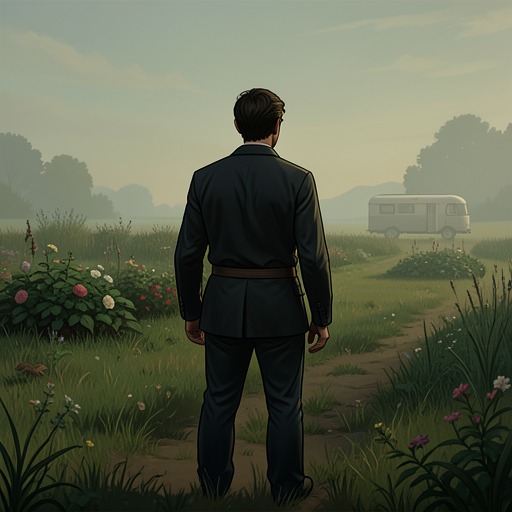
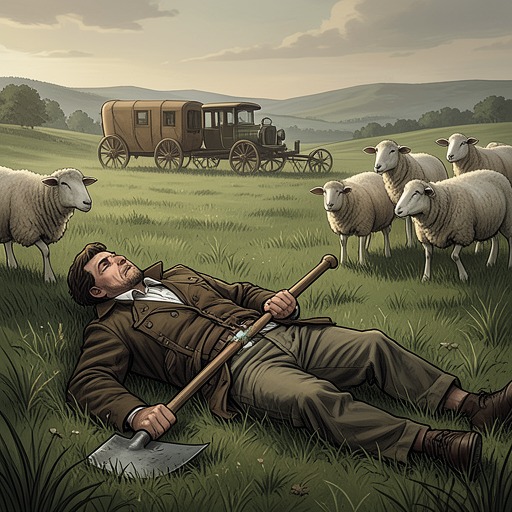
George Glenn’s suicide and the staging of his death
Three Bags FullGeorge Glenn’s suicide and the staging of his death overturn the flock’s murder investigation: the apparent victim had chosen his own death, and Beth had helped make it look like a killing. The truth emerges not from a forensic discovery but from Beth’s painful recollection, which gives the spade a new meaning and forces the sheep to confront a human choice they cannot readily understand.
The farewell and the choice
Beth recalls that George came to her door late one evening, on the Sunday before last. She was still awake and began, as she usually did when they met, to speak about the Gospel. This time he stopped her gently, saying that what he had come to tell her was important. Beth’s response was to assume that he was finally leaving for Europe, the journey he had long anticipated. George told her he was afraid and could not go: in his eyes, it had become too late.
His words made the farewell final in a way Beth had not expected. He told her he would have it over with in an hour, in the meadow. She went there in pouring rain and found that he was already dead. Beth says she could not give him the courage to continue, and that she helped him do what he wanted because she feared that otherwise he would not be buried. Her account presents the act not as a sudden quarrel or an attack by another person, but as a decision she witnessed and was drawn into assisting.
The revelation also brings back an earlier failure of speech. Beth remembers handing George a handkerchief without saying what she wanted to say. At the time, she had felt hope so intensely that it frightened her; looking back, she names her silence as the great mistake of her life. When the handkerchief comes into view again, she shudders, and her fingers trace its lines before her hands clasp together for comfort. The small piece of cloth becomes a measure of what remained unspoken between them, and of the regret that survives the farewell.
The spade and the false murder
The flock’s question is not only how George died, but why the death had to look as it did. Beth explains that the spade was essential to George’s plan: he wanted the scene to give people something to think about. She had tried and failed to persuade him not to use it, and remembers the choice as terrible. The spade, which had supported the flock’s belief that a murderer was at large, is thus recast as part of the appearance George deliberately left behind.
That appearance has consequences. The sheep have been trying to clear up the murder of their shepherd, and Mopple the Whale has even carried a smelly rag to The Mad Boar as evidence. When the flock begins to understand Beth’s account, Zora carefully tests the implication: George murdered George. Fosco confirms that this is what happened, and names it suicide. The explanation is stark, but it does not make the death easy for the sheep to grasp. It replaces a familiar kind of mystery, in which an attacker must be found, with a word and a choice that George can no longer explain to them.
Beth’s truth is supported, for the sheep, by scent. Mopple insists that she is lying and still resists abandoning the murder explanation, but the flock can tell that Beth is not lying. Their recognition matters because the revelation is not simply accepted as a convenient account: it overturns their suspicions while leaving them with a kind of death that does not fit their understanding of George.
Loneliness, Europe, and the story of the death
Beth connects George’s decision with the loneliness she had watched around him. She says that he was always alone, with only his sheep, and that she had seen him move away from everything, step by step, toward something dark. Her words do not reduce the suicide to a single cause. Instead, they set his fear of going to Europe alongside the isolation she observed and the long delay that had made the journey seem both desired and impossible.
An earlier story Rebecca tells the flock offers a striking echo. It describes a girl with a secret father whom she loves, a quarrel that separates them, and a letter announcing that he hopes to travel to Europe but wants to see her first. The girl hides her happiness and keeps him waiting; he waits himself to death. The story does not replace Beth’s account, but its pattern of delayed reunion and lost time gives the later farewell a painful resonance. Europe had represented a future George wanted, yet at the threshold of leaving he told Beth that he was afraid and that it was too late.
What remains unresolved
After the truth is revealed, Rebecca says that Beth has been different since the flock’s appearance at the Smartest Sheep in Glennkill contest, where four of the sheep took part. Rebecca calls her the most romantic person she knows. The sheep understand that their action at the contest mattered, even though they are not sure exactly what it accomplished; its consequence includes bringing George’s death into a new light for those who had lived with the false murder story.
The flock still cannot understand why George, of all people, would have chosen suicide. Rebecca can only imagine that, right up to the end, he may have believed he would go to Europe after all, before taking a different journey. She passes a hand over her reddened eyes. The mystery of who killed George has been answered, but the emotional question remains: how a shepherd who usually made himself understandable to sheep could reach a decision they could not share or explain.